

Myopia Management
Helping children see clearly today while slowing the progression of nearsightedness for a healthier tomorrow.
Over one-third of the world’s population has myopia — a figure projected to reach 50% by 2050. In the U.S., nearsightedness has climbed from about 25% in earlier decades to more than 40% today, and it’s rising quickly, especially in children.
THE BASICS
WHAT IS MYOPIA?
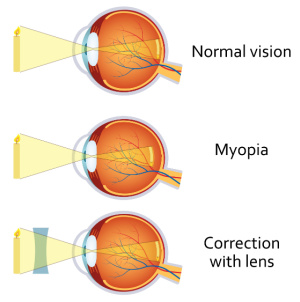
Myopia, also known as nearsightedness, causes poor long-distance vision. In myopic eyes, the eyeball is either longer than normal or the cornea is too curved, causing objects far away to appear blurry.
When the eyeball is elongated or the cornea is too curved, light falls short of the retina instead of focusing on it — so distant objects look blurry. It’s just like a projector: the image won’t be clear if the screen is positioned too far from the projector.
MYOPIA RISK FACTORS
Several factors can increase a child’s likelihood of developing or worsening myopia.
2+ hrs MORE CLOSE WORK
Two or more hours a day of "close work" (not including school work) can increase the risk of myopia.
25–50% MYOPIC PARENTS
A child has a 25% chance of developing myopia if one parent is myopic, and 50% if both parents are.
VISION & focus DISORDERS
Specific binocular vision and focusing disorders increase the risk of myopia.
Under 9 EARLY ONSET
Myopia progresses faster at an early age, especially if a child is younger than nine years old.
60–90 min LESS NATURAL LIGHT
Fewer than 60–90 minutes a day spent outdoors in natural sunlight could contribute to myopia.
WHY MYOPIA CONTROL IS IMPORTANT
Beyond blurry vision, myopia raises the long-term risk of serious, sight-threatening conditions. Controlling it early helps protect your child’s future vision.

CATARACTS
Cataracts tend to develop sooner in nearsighted eyes.

GLAUCOMA
Nearsighted people have a two-to-three times greater risk of glaucoma.

RETINAL DETACHMENT
Nearsightedness increases the risk of retinal detachment.

MYOPIC MACULOPATHY
A prescription over −6.00D poses a 40× increased risk of degeneration of the central retina.
WAYS TO SLOW MYOPIA

INCREASE TIME OUTSIDE
More time outdoors promotes healthy eye growth, helps slow progression, and reduces the chance of onset.

DECREASE SCREEN TIME
Less screen time helps too. Try the 20-20-20 rule: every 20 minutes, take a 20-second break to look at something 20 feet away.

TREATMENTS & PRESCRIPTIONS
Treatments such as MiSight® can slow the progression of myopia and are easy and comfortable to wear.
TREATMENT OPTIONs
Every child’s eyes are different, so there’s no single answer to slowing myopia. At Lake Lanier Eye Care, we offer three effective approaches — MiSight® 1 Day contact lenses, overnight Ortho-K corneal reshaping, and atropine eye drops. After evaluating your child’s vision and how their myopia is progressing, we’ll recommend the option best suited to their needs and lifestyle.
MISIGHT®
Your child leads an active life — from playing sports to spending time with friends to attending school — and myopia can make doing their favorite things more challenging. Lake Lanier Eye Care is proud to offer MiSight®, a new FDA-approved contact lens that works to slow the progression of nearsightedness in children.
MiSight® 1 Day Contact Lenses
Your child will love MiSight® 1 Day Contact Lenses because they’re soft and easy to use, giving them clear vision and freedom from glasses. They’ll be able to enjoy the activities they love while slowing the progression of myopia.


Clear vision, freedom from glasses, and slower myopia progression — it’s a win-win.
MiSight® & Myopia FAQs
When it comes to your child’s vision, we understand you may have questions. We’ve compiled the most frequently asked questions we receive about MiSight and Myopia for you. If you still have questions, please contact our team!
What is Misight®?
MiSight® 1-day contact lenses, the only FDA-approved contact lenses, slow the progression of myopia in children between the ages of eight and twelve. This new treatment has been shown to reduce myopia progression by more than half compared to other myopia treatments.
Why is Controlling Nearsightedness Important?
How Does Misight® Work?
ORTHOKERATOLOGY
Many patients with vision problems heartily embrace the idea of enjoying vision correction without having to wear eyeglasses or contact lenses. Not all of these patients, however, are good candidates for PRK or Lasik surgery, the two standard surgeries used to alter the way the cornea of the eye refracts light. If that describes you, don’t fret – because here at Lake Lake Lanier Eye Care, we offer an advanced corneal reshaping technique known as orthokeratology (or Ortho-K). Continue reading if you’re interested in learning more about this state-of-the-art solution.
How Ortho-K Works
The doctors at Lake Lanier Eye Care will map the shape of your corneas precisely and then fabricate special contact lenses. Unlike standard contacts, you’ll wear these lenses at night. The lenses gently reshape the cornea while you sleep, so you can take them out the next morning and enjoy perfect or near-perfect vision.
Ortho-K can help you see clearly for a day or two at a time, possibly even longer. By wearing the lenses regularly at night, you can maintain your clarity of vision for as long as you choose to continue. If you decide to use another form of correction, simply stop — and your corneas will gradually return to their previous shape. It’s completely reversible.

Is Ortho-K Right for Me?
While you might leap at the thought of permanently correcting vision problems, laser surgery isn’t always the best eye care option. For instance, if you suffer from thin corneas, untreated cataracts, diabetes, certain autoimmune diseases, or a corneal disease called Keratoconus, you should avoid laser eye surgery.
Some of our patients simply don’t like the idea of any kind of surgery, or they want a reversible procedure. Orthokeratology may be an ideal choice for these individuals.
Ortho-K FAQs
Many of our patients have not heard of Ortho-K before. Learn more about this solution and if it’s right for you or a member of your family.
What is Ortho-k?
The lenses subtly reshape your cornea while you sleep. This means when you take them out the next morning, you’ll be able to see perfectly or near-perfectly. By wearing them regularly each night you can maintain your perfect vision for as long as you decide to continue using them.
How Does Ortho-k Work?
The lenses subtly reshape your cornea while you sleep. This means when you take them out the next morning, you’ll be able to see perfectly or near-perfectly. By wearing them regularly each night you can maintain your perfect vision for as long as you decide to continue using them.
How Long Does Ortho-k Last?
Ortho-K can help you see clearly for one or two days at a time. If you wear them consistently, you can maintain your clear vision for as long as you continue wearing them. In the case you decide to use a different form of vision correction, all you need to do is stop wearing your Ortho-K lenses and your corneas will assume their previous shape.
What Are the Risks of Ortho-k?
The FDA has declared Ortho-K lenses safe for use by patients of all ages – including young children. The risks for Ortho-K lenses are very similar to the risks of wearing any type of contact lenses. The most common risk is an infection in the eye caused by inadequate hygiene. It is imperative to properly clean your hands and disinfect the contact lenses before each use!
Is Ortho-k Right for Me?
We typically recommend Ortho-K lenses to patients who are looking for vision correction for myopia but don’t want to wear glasses or contact lenses. We also recommend these lenses for those who suffer from dry eye or who have trouble wearing regular contact lenses. Ortho-K lenses are also a great solution for adults and children who are active in sports.
Is Getting Ortho-k Complicated?
No! The process of being fitted for Ortho-K lenses is only slightly longer than a typical contact lens fitting and has a high success rate so you can be sure your lenses will fit properly after your appointment!
ATROPINE EYE DROPS
One theory about the progression of myopia is that it’s associated with eye strain — the added stress placed on the eye when straining pushes it further out of its proper shape. Atropine eye drops are specifically designed to help stop the eye from straining and to help the focusing muscles relax.
Atropine is similar to the drops used when you get your eyes dilated, but it lasts throughout the entire day rather than just a few hours. It dilates the pupil and prevents it from closing too tightly and limiting your vision.

STELLEST® LENSES
Stellest® lenses look and feel like an ordinary pair of glasses, but they do two jobs at once — correcting your child’s nearsightedness so they see clearly today, while gently cueing the eye to grow more slowly over time. They’re the first eyeglass lens to receive FDA authorization for slowing childhood myopia.
How Stellest® works
Is Stellest® right for my child?
Made for school-age children (roughly 6–18) whose prescriptions climb year to year — the earlier it begins, the better it works. It suits mild through strong prescriptions and works best as an all-day main pair.
STELLEST® FAQS
What are Stellest® lenses?
How do Stellest® lenses actually slow myopia?
How many hours a day does my child need to wear them?
Is my child a good candidate for Stellest®?
Are Stellest® lenses safe?
Yes. Stellest® is the first spectacle lens to earn FDA market authorization for slowing myopia progression, which reflects a rigorous review of its safety and effectiveness. Because they’re worn like normal glasses, there are no drops, no lenses to insert, and no special hygiene routines. Keep in mind that myopia control slows progression rather than stopping or reversing it — your doctor will set clear expectations.
WHAT FAMILIES SAY
We value our patients’ experience at Lake Lanier Eye Care. We’re proud to have received over one hundred five-star reviews — read success stories from all over Sugar Hill, Cumming, Buford, and Suwanee.
“I have been a patient of Lake Lanier eye care for many years and they provide top notch eye care and premium service. The office is pleasant and the staff is very helpful. I would recommend them to all who need an eye exam and other eye care services.”
Chuck A.
“I had the best experience at Lake Lanier Eyecare! I was immediately greeted by two friendly ladies who went over my benefits and cost for the day, and it was only a moment before I was taken back to start my eye exam. Everything was explained to me fully while it was being done. It was my first time seeing Dr. Black and he was thorough, patient and answered all my questions. Great service with a personality! 100% recommend!”
Kayla S.
“Great experience. Everyone from the front desk staff to everyone in the back doing tests are professional and friendly. Dr. Black made sure to find the perfect fit for my contact’s. He listen to every issue I had and addressed it.
This is a must come to place for your eye problems. Happy I made the switch.”
James C.
“What a fantastic experience. Everyone here is friendly, and professional. Dr. Kapoor was a wealth of knowledge. My daughter and I went together, both with different issues, and he took the time to answer our questions. From the front desk to the selection of glasses, to the picking up of our classes was 5/5. Every touch point was easy. The atmosphere is light and cheery.”
Anne M.